
Liquid cooling solutions
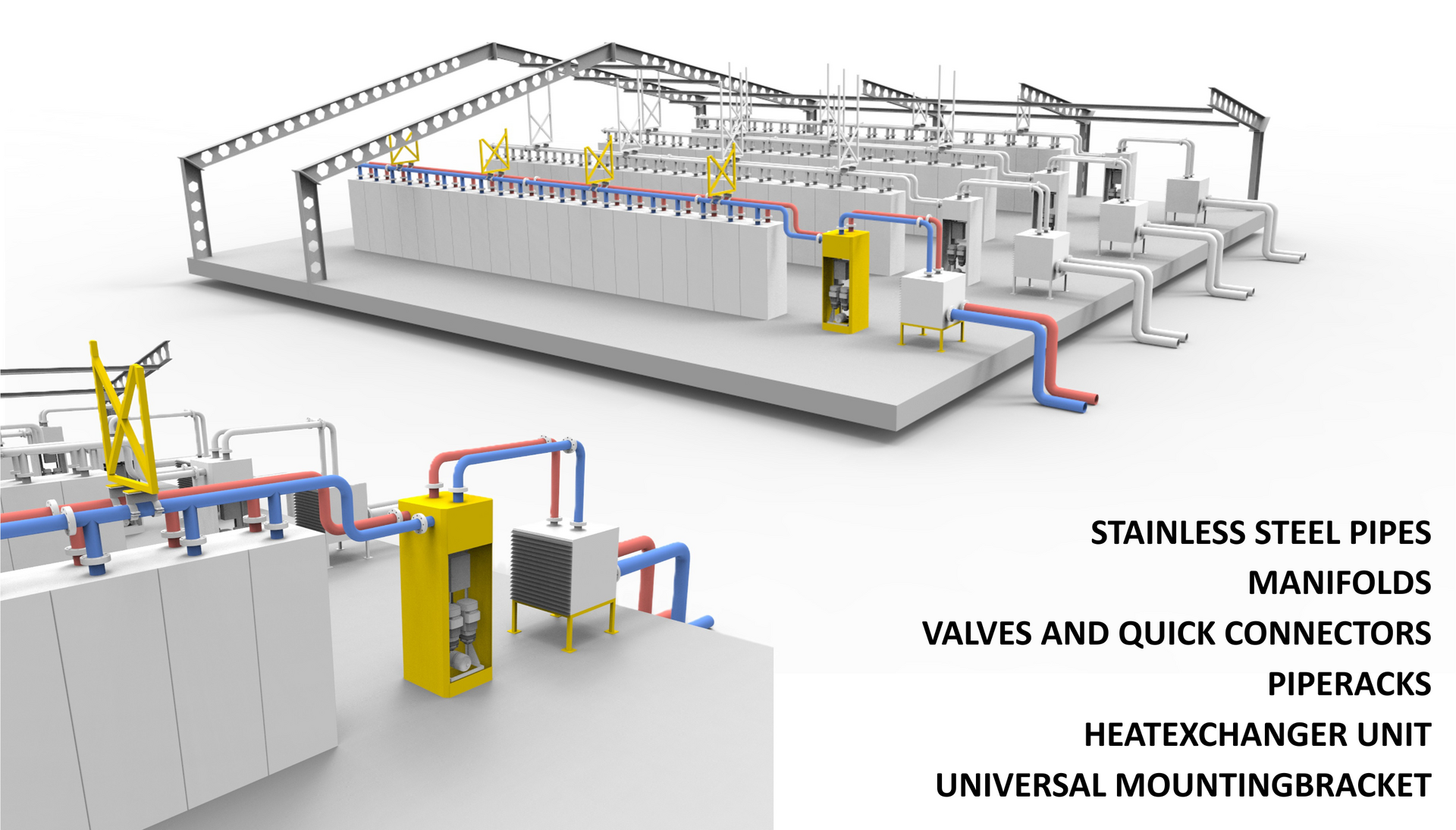
We have experience in manufacturing liquid cooling equipment. Our production includes heat exchanger units, piping, manifolds, and pipe racks. For liquid cooling solutions, we use materials such as stainless steel AISI 316, acid-resistant steel AISI 316L (1.4404), and PVC plastic. Steel piping is welded using the TIG method. The company holds Welding Procedure Qualification Records (WPQR) for stainless steel welding, and our welders strictly follow Welding Procedure Specifications (WPS). We also employ two certified International Welding Specialists (IWS).
During manufacturing, the piping undergoes a thorough cleaning process. Finished pipe assemblies are pickled, which removes impurities from welding and fabrication while restoring the protective oxide layer. After the acid bath, the surfaces are treated with a neutralizing to ensure corrosion protection. The internal cleanliness of the pipes guarantees a long service life and minimal flow resistance. Before shipment, all pipes are made dust-proof.
The piping can be customized according to customer needs with various fittings, valves, and quick couplings. Each pipe can also be individually identified based on customer requirements. We are capable of manufacturing piping in various sizes and designs that save equipment space and fit seamlessly into cabinet structures. Plastic brackets are used for securing the piping. We fully understand our customers’ strict quality and cleanliness requirements, and we maintain an extensive network of material and component suppliers. The systems we manufacture utilize a water-glycol mixture.
We also have experience in high-capacity heat exchanger solutions and understand the specific requirements for piping in various liquids. For seawater applications, we have utilized acid-resistant piping and titanium heat exchangers for heat recovery.
We aim to be a development partner for our customers. We can engage as early as the design phase to offer our expertise and help optimize the product for manufacturability. We also provide rapid prototyping, with the capability to deliver test piping with short lead times.
Examples
Example Case: Electrical Equipment
For example, a variable frequency drive (VFD) system with an electrical power of 1 MW generates a heat loss of approximately 2–3%, requiring around 30 kW of cooling capacity. The largest heat exchanger unit we have manufactured is 300 kW, meaning it can support an electrical system with a capacity of up to 10 MW. The heat exchanger unit offers flexible installation; it can be integrated directly into the electrical cabinet or placed in a separate equipment room. The piping we manufacture is integrated into the same cabinet or space as the electrical equipment. We have also manufactured cooling mainlines installed inside buildings. Additionally, we possess experience with seawater heat exchangers.
Benefits of liquid cooling in electrical equipment:
- High cooling capacity
- Reduced space requirements
- No need for large fans
- Tight enclosure options for electrical equipment (high IP rating)
- Waste heat can be efficiently transferred to the district heating network
- Quiet operation
- Stable temperatures for cabinet components, reducing mechanical stress from thermal expansion
Example Case: Data Centers
The computing power in data centers generates vast amounts of heat, which can be efficiently transferred and repurposed using liquid cooling.
Benefits of liquid cooling in data centers:
- Improves energy efficiency
- Closed-loop liquid systems consume minimal water
- Environmentally friendlier data center operations
- Lower noise levels
- More compact equipment, saving valuable floor space
- Efficient recovery of waste heat
- Enhanced performance and reliability
- Heat is effectively dissipated right where it is generated
- Quiet and dust-free equipment rooms
- Stable component temperatures, reducing mechanical stress from thermal expansion
Other Electrical Applications for Liquid Cooling
- Energy storage systems (ESS)
- Wind turbines
- Transformers
- High-power chargers (HPC)
- Industrial PCs